Before you compare salon towel service quotes, total up what in-house laundry is already costing you. Most owners never have.
In April 2002, Inez Gray was woken by a phone call telling her that Habitude, her Seattle salon, was on fire. Oil-saturated spa towels had been left warm in the dryer overnight and combusted. She lost a million-dollar build-out and more than $250,000 in equipment and product, and salvaged little beyond the hard drives.
The detail that should bother you is that the dryer was switched off when the fire started.
It keeps happening, and mostly to people who thought they were being careful. An insurer's loss file describes a spa where an overnight load filled the laundry room with smoke. Two days later the same shop, working through the backlog, put used linens into plastic bins to deal with in the morning. That fire took the building, and the owner reported $600,000 in damages. A fitness centre lost more than six months of trading and roughly $1 million after sheets carrying massage oil went into a dryer. The massage therapy associations have been warning members about this for years.
It isn't only individual bad luck either. In 2022 UK fire services put out a warning to salons, spas, pubs and restaurants after a run of tumble dryer blazes, and the laundry trade press there reckons the commercial sector alone loses one or two plants a year to un-removed oil on textiles.
If you run a spa, a massage or physio clinic, or a salon doing any oil-based treatment, this risk is sitting in your back room right now. It's also, oddly, the cheapest of the three problems with doing your own laundry.
Why towels catch fire
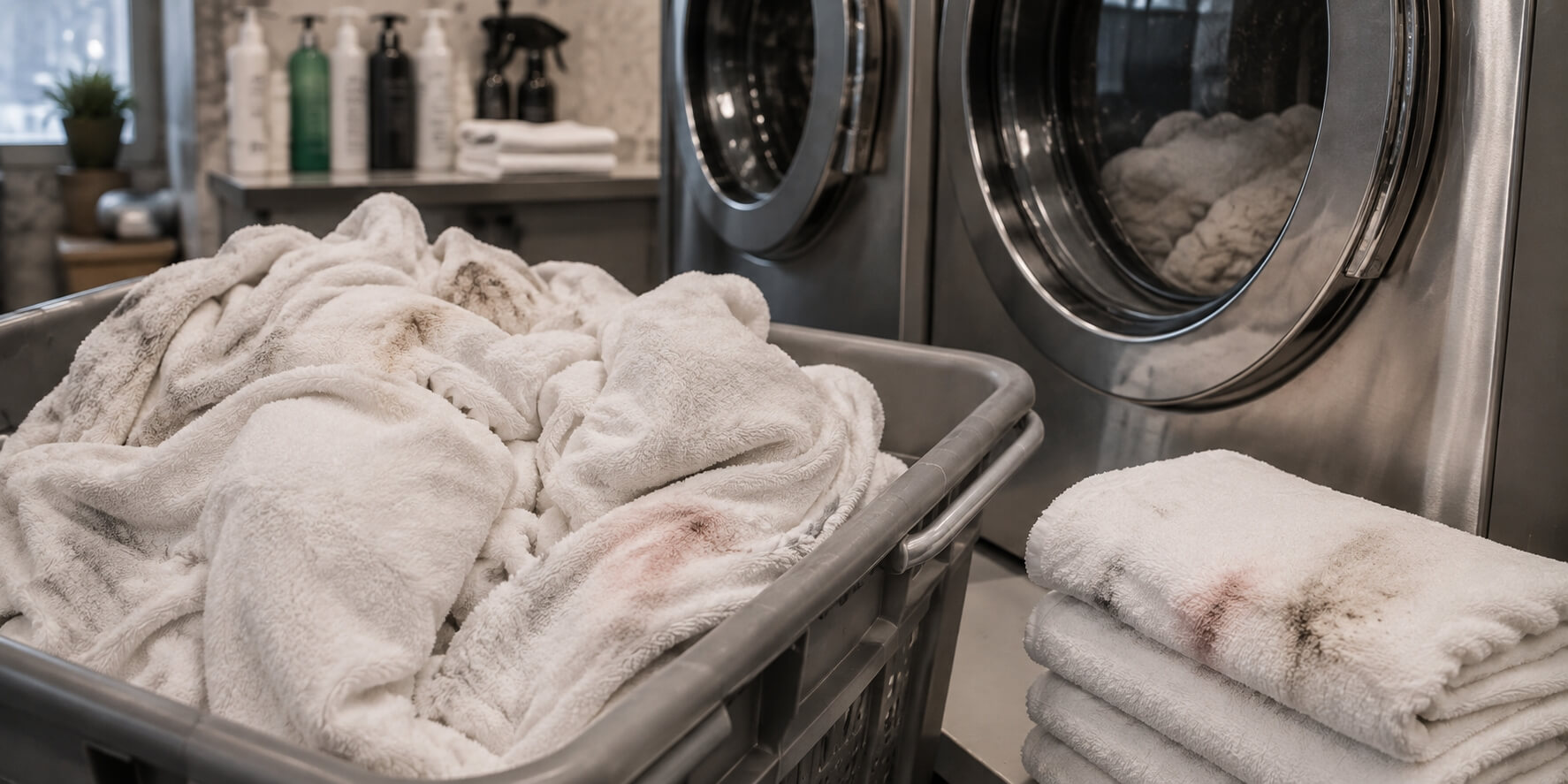
Oil oxidises, oxidation releases heat, and in a dryer drum or a bin of scrunched towels that heat has nowhere to go. It builds until it reaches the oil's ignition point.
The temperatures are lower than people assume. Great American's loss control guidance notes that common essential oils are classed as flammable liquids with flash points between roughly 102 and 140°F. Tea tree, lavender, citrus, eucalyptus. A domestic dryer on low heat runs around 125°F. That overlap is the whole problem.
Washing cool makes it worse, because the oil never emulsifies and just stays in the fibre. The towel looks clean and still carries fuel.
If you're handling this in-house: wash oil-exposed linen hot, use an emulsifier rather than ordinary detergent, and finish the dryer's cooling cycle. That last one gets skipped constantly, because it's exactly when a tired staff member decides the load is done.
Your inspection record is public
If you run a salon or spa in Calgary or Edmonton, personal service facilities fall under the Public Health Act, the Personal Services Regulation, and the AHS Personal Services Standards.
That's the framework your inspector works from, and hairstyling has been regulated in the province since 1925.
Linens must be changed between clients and laundered at appropriate temperatures. Inspectors treat this as a basic control, because towels, combs, and brushes carry a real if limited transmission risk for ringworm, staph, and head lice.
Alberta inspection results have also been publicly searchable online since April 2023. A client in Calgary can look your salon up before booking, and a record showing closure for major violations is not something you quietly fix. British Columbia and Ontario run equivalent regimes under their own public health legislation, so the principle holds wherever you are.
In-house laundry doesn't make you non-compliant. Plenty of well-run shops manage it. It does mean compliance sits with whoever happened to be closing that night.
Where salon laundry costs actually hide
A busy salon goes through 60 to 120 towels a day. A spa adds sheets and robes. Call it three to five loads, every day you're open.
Somebody runs those loads, and in almost every shop we've worked with it's an apprentice or the last person on shift. Roughly 45 minutes to an hour, most of it folding.
An hour a day at $19 is about $580 a month, near enough $7,000 a year, on a task that generates no revenue. That's before you count that your apprentice folding towels is an apprentice not shampooing and not learning the thing you hired her to learn.
Domestic washers are engineered for around eight loads a week. Running 30 through one doesn't void the warranty so much as compress a twelve-year life into two or three, and most owners have replaced a washer without ever filing it under laundry.
Then there's churn. Colour, bleach, and developer destroy towels. Wax and oil stain them for good. Replacing 150 towels a year at $5 each is another $750 sitting quietly in the supplies budget.
A mid-sized salon is often carrying eight to ten thousand a year in laundry costs it has never totalled, because the money is scattered across payroll, supplies, and equipment instead of appearing on one line.
Work out your own number
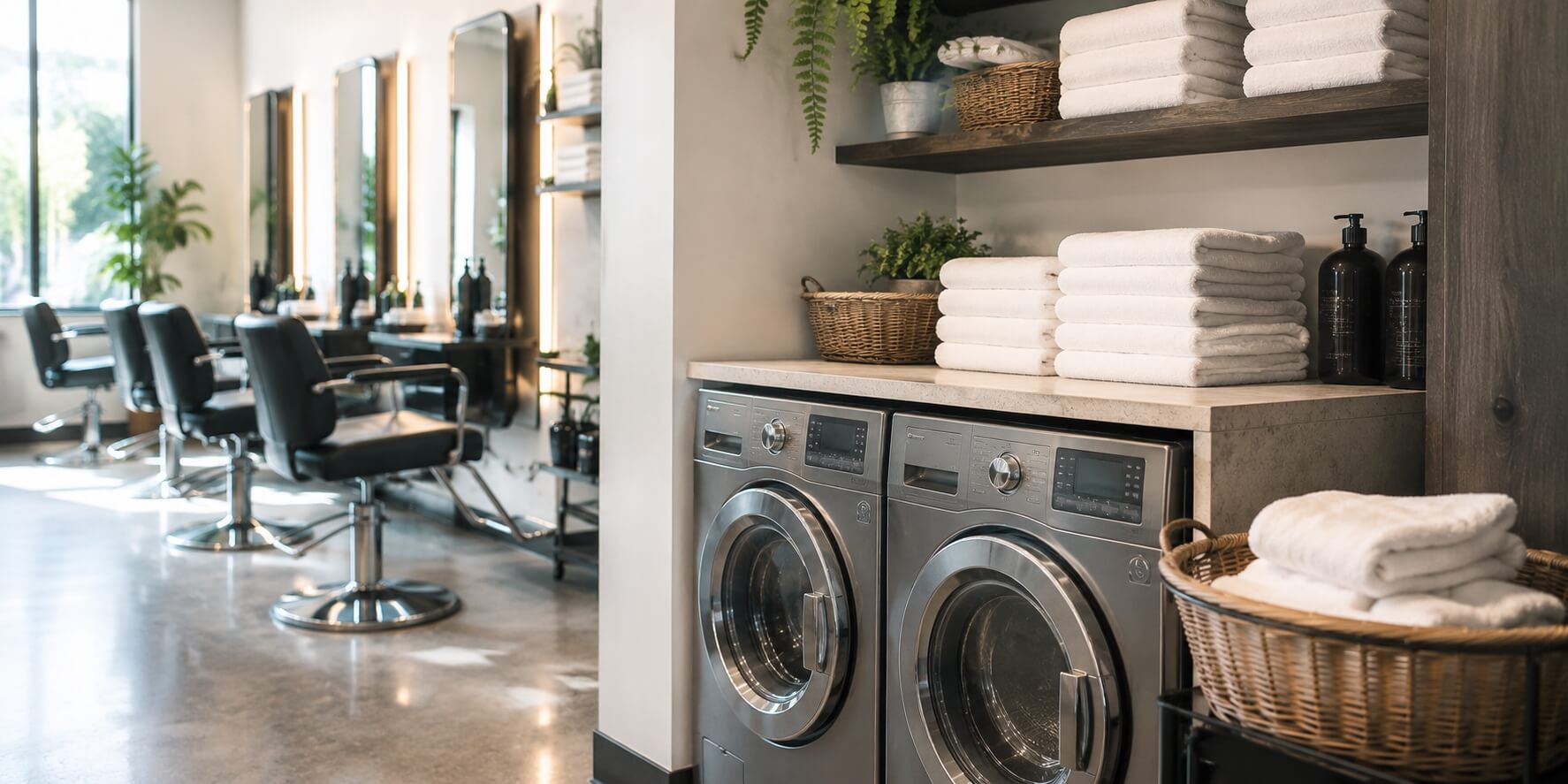
Averages are useless for this. The audit takes about ten minutes with your payroll and supplier invoices in front of you.
| Cost item | Your figure |
|---|---|
| Staff hours on laundry per week × hourly wage × 52 | $7,000 |
| Water, power, detergent (roughly $2 per load × loads per year) | $400 |
| Washer and dryer replacement cost ÷ years they actually last | $250 |
| Towels and linens replaced last year | $750 |
| Repairs and callouts last year | $100 |
| Your real annual laundry cost | $8,500 |
Divide your annual total by 52, then divide that by your provider's per-pound rate. The answer is your break-even weekly poundage.
If you're laundering less than that each week, outsourcing costs you less than doing it yourself. If you're laundering more, it doesn't.
A salon totalling $8,500 a year is spending about $163 a week. At a $2.25 retail per-pound rate, that breaks even at roughly 72 pounds a week, which is around 160 towels. A quiet three-chair salon or a solo massage practice sits comfortably under that. A busy six-chair colour salon does not, and will not, and nobody in this industry will tell you so.
Retail per-pound pricing is built for households, and it stops making sense somewhere north of 100 pounds a week. Past that point you need a commercial rate, and if a provider quotes you their consumer price for a 300-pound week, they haven't run your numbers either.
Where in-house still wins
Run the audit and some of you will find you should keep doing it. A one-chair barber or a solo esthetician seeing five clients a day is running one load while they clean down. Anyone who's already bought a commercial washer has paid the capital cost and has proper temperature control.
What to ask a salon towel service, us included
Can they document wash temperatures if an inspector asks? Do they handle oil-exposed linen separately, with an emulsifier rather than standard detergent? Does the turnaround hold on your busiest day rather than your average one? Are they insured for your stock while it's in their van?
Vagueness on the first two means they haven't thought about spas.
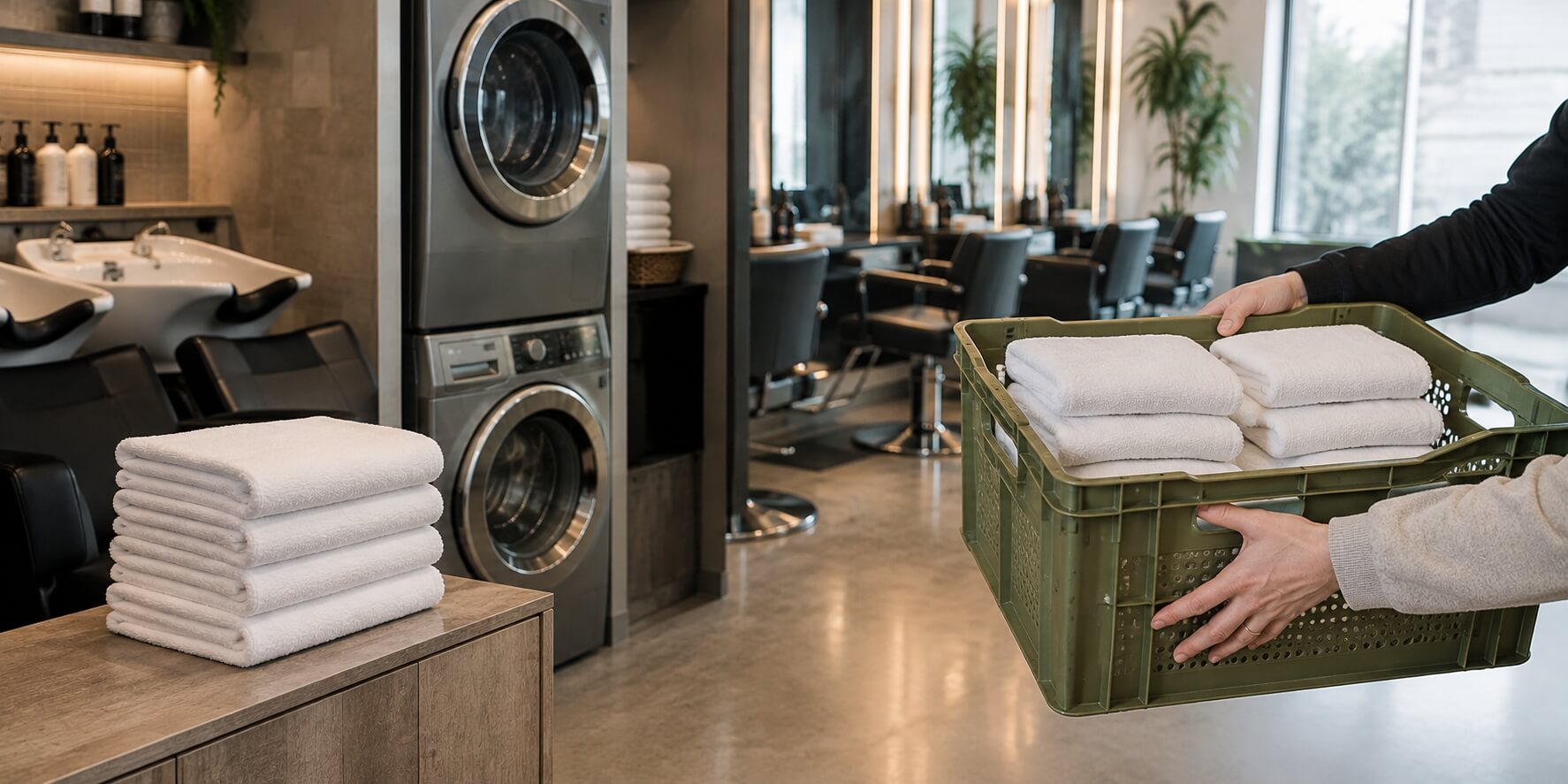
We run pickup and delivery for salons, spas, and clinics in Calgary, Edmonton, Vancouver, and Toronto. If your audit puts you under your break-even, our standard per-pound rate is on the pricing page. If it puts you over, ask us for a commercial quote instead.